
Perché la gamification rischia di essere un flop

[…] Molte persone stanno saltando sul carrozzone dell’anti-gamification nato di recente. […]

[…] E’ perché i sostenitori della gamification generalmente non sono game designer e non capiscono quanto è difficile creare un buon gioco? In alcuni casi probabilmente è così. C’è però un problema più profondo e pervasivo che sta spingendo a questa semplificazione estrema della gamification: è veramente difficile da vendere. […]

Continua a leggere: Why Does Gamification Tend to Devolve?.

Why Does Gamification Tend to Devolve?

[…] Lots of people have been jumping onto the anti-gamification bandwagon lately. […]

[…] Is it because the proponents of gamification are generally not game designers and don’t understand how hard it is to make a good game? In some cases, probably so. But there’s a deeper and more pervasive problem that is driving the “dumbing down” of gamification. The problem is: gamification is a very tough sell. […]

Read more: Why Does Gamification Tend to Devolve?.

Le statistiche di diffusione dell’uso della gamification nelle digital agencies britanniche

[…] Aziende ed agenzie stanno continuando a sviluppare tecniche innovative per aiutare ad incoraggiare la partecipazione dei clienti, prendendo in prestito features dagli ambienti del social gaming e networking. Piccole ma significative percentuali di tali compagnie stanno utilizzando tecniche quali eventi a tempo (18%), ricompense per particolari comportamenti online basati sulla partecipazione (16%) e interfacce ludiche (10%). […]

[…] “In termini generali, le imprese sono più inclini all’uso dei social media e dei canali mobile per approfondire le relazioni con i clienti e migliorare la qualità dei servizi, anche attraverso l’uso di social network, Twitter, applicazioni mobile e marketing location-based”.
“La ‘gamification’ è un trend importante. Al momento solo una minoranza sta utilizzando feature ispirate al mondo del gaming come interfacce ludiche, classifiche per il cliente migliore e livelli di accesso che dipendono dall’entità della partecipazione. E’ però atteso un’aumento dell’utilizzo di queste tecniche in futuro grazie alla ricerca di nuovi vantaggi competitivi da parte delle aziende”. […]

Continua a leggere: Companies blurring lines between social and corporate platforms.

Nice stats on the spreading of gamification use in UK digital agencies

[…] Companies and agencies continue to develop innovative techniques to help foster customer engagement, borrowing features from social gaming and networking. Small but significant percentages of companies are now using techniques such as time-limited activities (18%), rewards for online behaviour based on engagement (16%) and playful interfaces (10%).[…]

[…] “Broadly speaking, businesses are now more likely to be using both social media and mobile channels to deepen customer relationships and improve levels of service, including through the use of social networks, Twitter, mobile applications and location-based marketing.

“’Gamification’ is an important trend. At the moment, only a minority are using game-inspired features such as playful interfaces, top customer charts and levels of access which depend on the extent of engagement. But expect uptake of these techniques to increase in the future as companies seek to gain a competitive advantage.” […]

Read more: Companies blurring lines between social and corporate platforms.

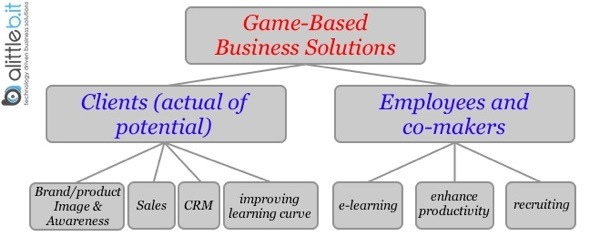
Destinatari e obiettivi delle soluzioni game-based per il business

game-based business recipients and objectives
Le soluzioni game-based per il business traggono vantaggio dai paradigmi della gamification e usano gli strumenti del game-based business marketing (si faccia riferimento al nostro post precedente). Quali sono i destinatari e gli obiettivi di questo tipo di soluzioni?

I destinatari si possono dividere in due categorie principali:

  • Clienti (attuali o potenziali): rappresentano l’intera richiesta di mercato e includono sia i clienti attuali, che quelli che possono essere raggiunti dalla diffusione del prodotto o servizio, attraverso campagne di comunicazione virali o tradizionali.
  • Impiegati e co-makers: rappresentano un gruppo molto specifico; la soluzione è spesso sviluppata su misura per una particolare necessità, in relazione all’aumento della produttività, alla comunicazione della cultura aziendale o al test di skill lavorative in ambienti simulati.

Read More

The recipients and objectives of game-based business solutions

game-based business recipients and objectives
Game-based business solutions can take advantage of the paradigms of gamification and use the instruments of the game-based marketing (see our previous post). But which are the recipients and the objectives of these kinds of solutions?

Recipients can be divided into two main different categories:

  • Clients (actual of potential): they are the whole market demand and they include both the actual clients and the ones that can be reached by the diffusion of the service or product, encouraged by the spreading of viral or traditional communication campaigns.
  • Employees and co-makers: they represent a very specific group and the solution is often tailored to fulfill a particular need, related to the enhancement of the productivity, the communication of the corporate culture or the testing of working skills in a simulated environment.

Read More

Tre trend per i social game nel 2011 | Gamasutra: Joost Rietveld’s Blog

I Social game, che hanno sia espanso che diversificato la popolazione dei videogiocatori, stanno maturando a passi rapidi; sebbene ne risultino fenomeni di consolidamento, permangono anche ampi spazi di innovazione.
In questo articolo (considerati i risultati del Social Gaming Summit del 2010, le varie attività di consulenza nel settore del social gaming e le pubblicazioni accademiche sull’argomento) verranno presi in considerazione i tre principali trend che rivoluzioneranno i social game nel 2011.

Trend 1. Social Game anche su dispositivi Mobili – smartphone e tablet

’Il 2011 vedrà crescere il numero di mobile social game, sia su Facebook, sia su altre piattaforme come iOS (Apple), Android Market e HTML5.’

Trend 2. Social Game Location-based

‘Incentivati da servizi location-based, il 2011 vedrà crescere la nicchia di prodotti in cui comunità coese saranno servite con prodotti e servizi innovativi’

Trend 3. Social Advergame

Quando propriamente sviluppato, un advergame è uno strumento di marketing estremamente efficace.
Già nel 2010 ha iniziato a nascere il fenomeno dei social advergame. Ad es. Disney, a Luglio 2010, ha acquisito lo sviluppatore di giochi social Playdom. McDonalds è stato il primo e più visibile brand a credere fortemente nel social advergaming, prendendo FarmVille per un giorno ed utilizzandolo come una gigantesca in-game advertising dinamica. Frima ha tentato di reiterare il successo di FarmVille per Mazda, sviluppando Mazda’s DriverVille.
‘Dato che le imprese si sono rese conto della forza dei social game e dei social media nel 2010, il 2011 vedrà un grosso aumento del numero dei social advergame’

Continua a leggere: Gamasutra: Joost Rietveld’s Blog – Three social gaming trends for 2011.

Three social gaming trends for 2011 | Gamasutra: Joost Rietveld’s Blog

Social gaming, both expanding and diversifying the gamer population, has been maturing at rapid pace resulting in heavy consolidation, while at the same time leaving room for innovation. Drawing in part on 2010’s social gaming summit, consultancy activities in the social gaming sector and academic interests, in this article I look at three broad social gaming trends for 2011.

Trend 1. Mobile Social Gaming

’2011 will see the rise of mobile social games, both on Facebook as well as on other platforms such as iOS (Apple), Android Market and HTML5.’

Trend 2. Location Based Social Gaming

‘Backed by location based services, 2011 will see the rise of niche products in which cohesive communities will be served with innovative and meaningful products.’

Trend 3. Social Advergames

When properly executed, advergames are an extremely effective marketing tool. Disney acquired social game developer Playdom in July 2010 with the likely rationale of brand proliferation of Disney’s intellectual property rights through Playdom’s games and reach. McDonalds was one of the first and most visible to actually engage in social advergaming by taking over Farmville for a day in the form of a gigantic in game dynamic advertisement. Whereas Frima has attempted to iterate on the success of Farmville in favor of Mazda by developing Mazda’s DriverVille.
‘As companies have become aware of the strength of social media in 2010, 2011 will see the rise of holistic social advergames.’

Read More: Gamasutra: Joost Rietveld’s Blog – Three social gaming trends for 2011.

Privacy Settings
We use cookies to enhance your experience while using our website. If you are using our Services via a browser you can restrict, block or remove cookies through your web browser settings. We also use content and scripts from third parties that may use tracking technologies. You can selectively provide your consent below to allow such third party embeds. For complete information about the cookies we use, data we collect and how we process them, please check our Privacy Policy
Youtube
Consent to display content from - Youtube
Vimeo
Consent to display content from - Vimeo
Google Maps
Consent to display content from - Google