

Needs and Motivations: why Games exist

Our brain evolved in order to encourage the personal success of each individual, through out a system that rewards purposes; and these purposes get beyond the mere concept of survival, although it is basic element for animals. Games and fun activities, therefore, see their Raison d’être in correlation with our ability to adapt, and the evolution of this ability: we play in order to unravel in everyday life, metabolizing rules, limits and targets, in order to grow as individuals and coping with hardships.Read More

Reciprocity Effect in Social Games

The third of the series of posts about the new objectives of game designers: today, game designers have to consider revenue issues and business models since the beginning of their creative processes.


Exploiting the power of “give and receive” social pattern certainly contributes to the strengthening of viral and attractive phenomenon and behaviours.
Reciprocity is a deep-rooted instinct in the human mind and many experts argue that it has played an important role in the development of modern society.
In social contexts, people interact with each other in similar ways: when someone gives a gift to you, you not only feel grateful and almost obliged to return the favour, but also your opinion of that person improves. Following this behavioural pattern is perceived correct; breaking it may cause a sort of confusion in the relationship between people.
In social games, players tend to behave according to this principle. Beyond enjoying the gifts received, doing the same can improve the personal image of the player. So, this creates a circle of strong viral and attractive reciprocity.
To fully exploit this type of dynamics, it is required to make the player’s actions observed – and therefore judged – by the other players. As game designers, it is particularly important to establish a clear sequence of in-game actions, which can create reciprocity expectancy, like “ Send gifts to your friends, and ask them to send one in return”.
Anyway, it is absolutely necessary to calculate very carefully this cycle: the feeling of “obligation” doesn’t always lead to expected results, particularly in long term, when it is perceived as a burden. The reciprocity effect is a double-edged blade with a great potential, but game designers should use it with attention and above all, with the skill to trigger it implicitly within the game.

MTV My Chart: Gamification & Cross-media Strategy


Project name: MTV MY CHART
Category: Gamification; Social Media Marketing; Facebook App; bidirectional Crossmedia strategy
Client: MTV Italy
Technologies: Flash – ActionScript 3.0, Facebook Connect, PHP


MTV My Chart is an application conceived and created by alittleb.it for MTV Italy, capable to create weekly videoclip charts, ordered by the preferences of the Facebook users.
MTV My Chart is placed in the charts section of the MTV.it portal (http://www.mtv.it/musica/classifiche/archivio/mychart.asp) and is connected to the social network using Facebook Connect and a Facebook Live Stream Wall; moreover, in the application page the users can check the trend of the My Chart in real time.

There’s more: MTV My Chart is a gamified application, usable as a tool for a bidirectional crossmedia strategy.

Read More

GAMECITY – Nickelodeon’s social meta-game

GAMECITY is the Nickelodeon’s social meta-game, hosted into nickTV.it and connected to Facebook.

Accessing to the new GAMECITY’s section on the Nickelodeon portal NickTV.it, users will dress the part of a superhero, equipped of a super-vehicle too, called to perform continuous missions in a city populated by all the famous properties of Nickelodeon, like Spongebob, Avatar, The Penguins of Madagascar, Fairly Oddparents.

Playing to the games contained into GAMECITY, performing their missions, matching their friends, players will increase their levels, climb GAMECITY’s leaderboards and earn continuously new virtual items to customize their own avatars, new playing cards to increase their super-vehicles powers, awards and prizes to testify their progresses.

GameCity is developed with our Social Game Development Platform: LUDUM.
LUDUM: Social Games Development Platform

The Advergame’s Concept

GAMECITY is a meta-game conceived to enhance at most the NickTV.it’s brand, exploiting all Nickelodeon’s properties (like Spongebob, Avatar, The Penguins of Madagascar, Fairly Oddparents an so on).

The main GAMECITY’s marketing objectives are:Read More

LUDUM – A Platform to Quickly Develop Flash Social Games

LUDUM

  • Single engine for both social games and Intranet Social E-learning or Productivity Games
  • Quicker development process leading to faster time to market
  • Already used on several successful cases (e.g. games for MTV, Nickelodeon, Astrazeneca)
  • Statistics and Google Analytics connection
  • Asynchronous multiplayer gameplay
  • Allow work-in-progress optimization and scheduled update

  • Alittleb.it introduces its new flash social game development platform: LUDUM

    LUDUM is a flexible technology that allows us to quickly develop customizable social games and advergames.
    LUDUM joins the existing Alittleb.it & DarkWave Games’ UnderWAVE: a proprietary framework to develop 2D multiplatform games (for iOS, Android, PC, Mac & Linux).

    Read More

    Avventura da Paura – Social Web Game

    Following the big success of Camp Orange’s Social Web Games, Alittleb.it has created the social game “Avventura da Paura” (Scary Adventure – Avventura da Paura’s Social Web Game) for MTV Italy and Nickelodeon. The game is published on nicktv.it portal – http://avventuradapaura.nicktv.it/gioco.html.

    Avventura da Paura is a Nickelodeon’s Adventure Broadcast-Game  that goes on air on Nickelodeon (the Mtv’s teen channel).

    alittleb.it created the game concept, the design and the graphics, and made an hard work on writing the Flash (AS3) and PHP5 code of the Web Game Avventura da Paura.

    Avventura da Paura is at most a reskin and upgrade of Camp Orange’s Social Web Games: this was possible because of the flexibility of our Social Game Development Platform (LUDUM).
    LUDUM: Social Games Development Platform

    Alittleb.it has developed the entire website www.avventuradapaura.it, too.Read More

    Game-Design Evolution – The Seven Deadly Sins Theory

    The second of the series of posts about the new objectives of game designers: today, game designers have to consider revenue issues and business models since the beginning of their creative processes.


    The lead designer of Settlers Online, Teut Weidemann, maintains that the first step for a game designer is to identify what makes a mechanic funny: it must be able to attract users.
    But, at the same time, it is necessary to consider the monetization power of that mechanic, since monetizing has become a crucial and essential part of game design.
    The technique adopted by Weidemann is interesting, but it is also cynical. It is based on the exploration – or rather, on the monetization – of human weaknesses, that he called The Seven Deadly Sins. Not only because of his name, it has caused a lot of reactions within the community of developers; however, in our opinion, it is a correct logic.

    VANITY
    Players love competition, and even more, they love to boast and to show how good they are and the goals they have achieved. Competing and cooperating at the same time is a very powerful dynamic which gets players to try to improve, also considering the progress of the others. This dynamic leads to the next sin….Read More

    Game-Design Evolution – Introduction

    This will be the first of a series of posts about the new objectives of game designers.
    Today, in fact, social-game designers have to consider revenue issues and business models since the beginning of their creative processes.


    Games are one of the main reasons why people visit Facebook. In fact, it is estimated that about 40% of users are online to play social games. This means that more than two hundred million people enjoy playing on Facebook every month, and that the top ten titles on social network can boast over twelve million users each.

    In the same way as the entertainment industry is rapidly moving toward online business models, for example cloud gaming, digital delivery and social gaming, so game designers need to adapt to this situation too. They have to develop their technical-cultural knowledge in order to link creativity with market laws, which have to be more and more aggressive and innovative; so, today, game designers have to find the perfect mix between fun factors and revenues.
    This does not imply a leveling of gameplay in favor of monetizing for its own sake: in fact, gameplay is gaining importance even more than before, because of the fierce competition and the staggering growth of the sector. However, gameplay is increasingly focused on simplicity and on the emotional stimulus rather than on actions to do or on th aesthetic depth of the ludic architecture.Read More

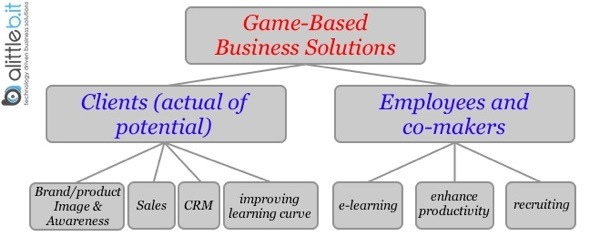
    The recipients and objectives of game-based business solutions

    game-based business recipients and objectives
    Game-based business solutions can take advantage of the paradigms of gamification and use the instruments of the game-based marketing (see our previous post). But which are the recipients and the objectives of these kinds of solutions?

    Recipients can be divided into two main different categories:

    • Clients (actual of potential): they are the whole market demand and they include both the actual clients and the ones that can be reached by the diffusion of the service or product, encouraged by the spreading of viral or traditional communication campaigns.
    • Employees and co-makers: they represent a very specific group and the solution is often tailored to fulfill a particular need, related to the enhancement of the productivity, the communication of the corporate culture or the testing of working skills in a simulated environment.

    Read More

    Privacy Settings
    We use cookies to enhance your experience while using our website. If you are using our Services via a browser you can restrict, block or remove cookies through your web browser settings. We also use content and scripts from third parties that may use tracking technologies. You can selectively provide your consent below to allow such third party embeds. For complete information about the cookies we use, data we collect and how we process them, please check our Privacy Policy
    Youtube
    Consent to display content from - Youtube
    Vimeo
    Consent to display content from - Vimeo
    Google Maps
    Consent to display content from - Google