

GAMECITY – Nickelodeon’s social meta-game

GAMECITY is the Nickelodeon’s social meta-game, hosted into nickTV.it and connected to Facebook.

Accessing to the new GAMECITY’s section on the Nickelodeon portal NickTV.it, users will dress the part of a superhero, equipped of a super-vehicle too, called to perform continuous missions in a city populated by all the famous properties of Nickelodeon, like Spongebob, Avatar, The Penguins of Madagascar, Fairly Oddparents.

Playing to the games contained into GAMECITY, performing their missions, matching their friends, players will increase their levels, climb GAMECITY’s leaderboards and earn continuously new virtual items to customize their own avatars, new playing cards to increase their super-vehicles powers, awards and prizes to testify their progresses.

GameCity is developed with our Social Game Development Platform: LUDUM.

LUDUM: Social Games Development Platform

The Advergame’s Concept

GAMECITY is a meta-game conceived to enhance at most the NickTV.it’s brand, exploiting all Nickelodeon’s properties (like Spongebob, Avatar, The Penguins of Madagascar, Fairly Oddparents an so on).

The main GAMECITY’s marketing objectives are:Read More
LUDUM – A Platform to Quickly Develop Flash Social Games

LUDUM

  • Single engine for both social games and Intranet Social E-learning or Productivity Games
  • Quicker development process leading to faster time to market
  • Already used on several successful cases (e.g. games for MTV, Nickelodeon, Astrazeneca)
  • Statistics and Google Analytics connection
  • Asynchronous multiplayer gameplay
  • Allow work-in-progress optimization and scheduled update

  • Alittleb.it introduces its new flash social game development platform: LUDUM

    LUDUM is a flexible technology that allows us to quickly develop customizable social games and advergames.
    LUDUM joins the existing Alittleb.it & DarkWave Games’ UnderWAVE: a proprietary framework to develop 2D multiplatform games (for iOS, Android, PC, Mac & Linux).

    Read More

    Avventura da Paura – Social Web Game

    Following the big success of Camp Orange’s Social Web Games, Alittleb.it has created the social game “Avventura da Paura” (Scary Adventure – Avventura da Paura’s Social Web Game) for MTV Italy and Nickelodeon. The game is published on nicktv.it portal – http://avventuradapaura.nicktv.it/gioco.html.

    Avventura da Paura is a Nickelodeon’s Adventure Broadcast-Game  that goes on air on Nickelodeon (the Mtv’s teen channel).

    alittleb.it created the game concept, the design and the graphics, and made an hard work on writing the Flash (AS3) and PHP5 code of the Web Game Avventura da Paura.

    Avventura da Paura is at most a reskin and upgrade of Camp Orange’s Social Web Games: this was possible because of the flexibility of our Social Game Development Platform (LUDUM).
    LUDUM: Social Games Development Platform

    Alittleb.it has developed the entire website www.avventuradapaura.it, too.Read More

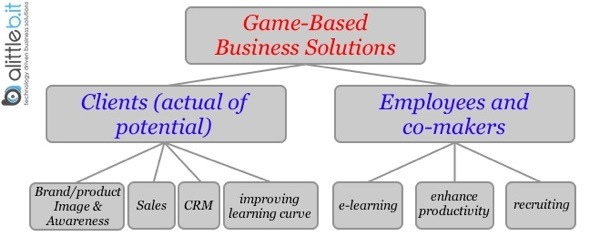
    The recipients and objectives of game-based business solutions

    game-based business recipients and objectives
    Game-based business solutions can take advantage of the paradigms of gamification and use the instruments of the game-based marketing (see our previous post). But which are the recipients and the objectives of these kinds of solutions?

    Recipients can be divided into two main different categories:

    • Clients (actual of potential): they are the whole market demand and they include both the actual clients and the ones that can be reached by the diffusion of the service or product, encouraged by the spreading of viral or traditional communication campaigns.
    • Employees and co-makers: they represent a very specific group and the solution is often tailored to fulfill a particular need, related to the enhancement of the productivity, the communication of the corporate culture or the testing of working skills in a simulated environment.

    Read More

    Three social gaming trends for 2011 | Gamasutra: Joost Rietveld’s Blog

    Social gaming, both expanding and diversifying the gamer population, has been maturing at rapid pace resulting in heavy consolidation, while at the same time leaving room for innovation. Drawing in part on 2010’s social gaming summit, consultancy activities in the social gaming sector and academic interests, in this article I look at three broad social gaming trends for 2011.

    Trend 1. Mobile Social Gaming

    ’2011 will see the rise of mobile social games, both on Facebook as well as on other platforms such as iOS (Apple), Android Market and HTML5.’

    Trend 2. Location Based Social Gaming

    ‘Backed by location based services, 2011 will see the rise of niche products in which cohesive communities will be served with innovative and meaningful products.’

    Trend 3. Social Advergames

    When properly executed, advergames are an extremely effective marketing tool. Disney acquired social game developer Playdom in July 2010 with the likely rationale of brand proliferation of Disney’s intellectual property rights through Playdom’s games and reach. McDonalds was one of the first and most visible to actually engage in social advergaming by taking over Farmville for a day in the form of a gigantic in game dynamic advertisement. Whereas Frima has attempted to iterate on the success of Farmville in favor of Mazda by developing Mazda’s DriverVille.
    ‘As companies have become aware of the strength of social media in 2010, 2011 will see the rise of holistic social advergames.’

    Read More: Gamasutra: Joost Rietveld’s Blog – Three social gaming trends for 2011.

    Game-mechanics and game-dynamics of the gamification process

    The process of gamification is based on the integration of typical game components into websites, online communities, content portals or business services and, in general, others non-gaming contexts.
    But what kind of techniques is needed to obtain the desired results?
    There are two different aspects to be considered during the gamification process: they are called game-mechanics and game-dynamics; the former are the tools needed to create the gamification infrastructure that lies under any game, the latter represent the human needs and desires that are inherently in everyone of us and can be satisfied taking advantage of game-mechanics.

    Read More

    Gamify your business – main goals

    Gamification has a couple of very interesting objectives that we are going to explain in details in this post.
    The first one is “to encourage an active and measurable behavior”. The implementation of gaming mechanics is one of the most efficient way to involve people in activities on the site or service. It’s a really special participation because it’s an active one: the user does something!
    It’s obvious that an active contribution is more efficient than a passive one because the communication message is connected to the action itself and is melted in the context of the experience.
    In this kind of environment lies another fundamental advantage: the behavior of the audience is measurable, gathering data based on actions that users do inside the game. In this way, it’s possible to profile the audience, focusing better on the target user or expanding the target audience.

    Read More

    An introduction to Gamification

    Gamification is a meta word that is gaining popularity day after day.
    The first part of it is made by game, a term often associated to fun and amusement without any particular purpose.
    There’s more: gaming is not only that but taking advantage of interaction is becoming a powerful means to convey messages of every kind.
    Among them you can consider the improvement of customer management, build loyalty and maximize the performance of employees and partners.

    It’s a really different point of view that shift the focus away from the traditional gaming market, based on the production of titles that have a great appeal on young males, and that can reach different demographic categories.

    Read More

    Privacy Settings
    We use cookies to enhance your experience while using our website. If you are using our Services via a browser you can restrict, block or remove cookies through your web browser settings. We also use content and scripts from third parties that may use tracking technologies. You can selectively provide your consent below to allow such third party embeds. For complete information about the cookies we use, data we collect and how we process them, please check our Privacy Policy
    Youtube
    Consent to display content from - Youtube
    Vimeo
    Consent to display content from - Vimeo
    Google Maps
    Consent to display content from - Google