

Game-Design Evolution – The Seven Deadly Sins Theory

The second of the series of posts about the new objectives of game designers: today, game designers have to consider revenue issues and business models since the beginning of their creative processes.


The lead designer of Settlers Online, Teut Weidemann, maintains that the first step for a game designer is to identify what makes a mechanic funny: it must be able to attract users.
But, at the same time, it is necessary to consider the monetization power of that mechanic, since monetizing has become a crucial and essential part of game design.
The technique adopted by Weidemann is interesting, but it is also cynical. It is based on the exploration – or rather, on the monetization – of human weaknesses, that he called The Seven Deadly Sins. Not only because of his name, it has caused a lot of reactions within the community of developers; however, in our opinion, it is a correct logic.

VANITY
Players love competition, and even more, they love to boast and to show how good they are and the goals they have achieved. Competing and cooperating at the same time is a very powerful dynamic which gets players to try to improve, also considering the progress of the others. This dynamic leads to the next sin….Read More
Why Does Gamification Tend to Devolve?

[…] Lots of people have been jumping onto the anti-gamification bandwagon lately. […]

[…] Is it because the proponents of gamification are generally not game designers and don’t understand how hard it is to make a good game? In some cases, probably so. But there’s a deeper and more pervasive problem that is driving the “dumbing down” of gamification. The problem is: gamification is a very tough sell. […]

Read more: Why Does Gamification Tend to Devolve?.

Nice stats on the spreading of gamification use in UK digital agencies

[…] Companies and agencies continue to develop innovative techniques to help foster customer engagement, borrowing features from social gaming and networking. Small but significant percentages of companies are now using techniques such as time-limited activities (18%), rewards for online behaviour based on engagement (16%) and playful interfaces (10%).[…]

[…] “Broadly speaking, businesses are now more likely to be using both social media and mobile channels to deepen customer relationships and improve levels of service, including through the use of social networks, Twitter, mobile applications and location-based marketing.

“’Gamification’ is an important trend. At the moment, only a minority are using game-inspired features such as playful interfaces, top customer charts and levels of access which depend on the extent of engagement. But expect uptake of these techniques to increase in the future as companies seek to gain a competitive advantage.” […]

Read more: Companies blurring lines between social and corporate platforms.

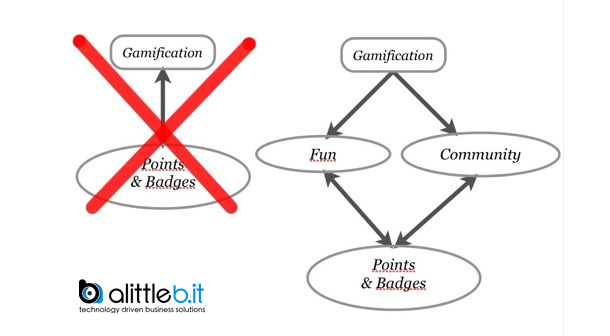
Why gamification is not a simple pointsfication

Gamification-Points-badges
As many other new disciplines, gamification is evolving day by day with new theories, emerging from studies in games design, human psychology, behavior and other academic fields.

We have already discussed about game mechanics and dynamics and their dominant role in producing a gamified environment. The next step is to focus on methods to apply those paradigms in the gamification process.
Read More

Game-mechanics and game-dynamics of the gamification process

The process of gamification is based on the integration of typical game components into websites, online communities, content portals or business services and, in general, others non-gaming contexts.
But what kind of techniques is needed to obtain the desired results?
There are two different aspects to be considered during the gamification process: they are called game-mechanics and game-dynamics; the former are the tools needed to create the gamification infrastructure that lies under any game, the latter represent the human needs and desires that are inherently in everyone of us and can be satisfied taking advantage of game-mechanics.

Read More

Gamify your business – main goals

Gamification has a couple of very interesting objectives that we are going to explain in details in this post.
The first one is “to encourage an active and measurable behavior”. The implementation of gaming mechanics is one of the most efficient way to involve people in activities on the site or service. It’s a really special participation because it’s an active one: the user does something!
It’s obvious that an active contribution is more efficient than a passive one because the communication message is connected to the action itself and is melted in the context of the experience.
In this kind of environment lies another fundamental advantage: the behavior of the audience is measurable, gathering data based on actions that users do inside the game. In this way, it’s possible to profile the audience, focusing better on the target user or expanding the target audience.

Read More

An introduction to Gamification

Gamification is a meta word that is gaining popularity day after day.
The first part of it is made by game, a term often associated to fun and amusement without any particular purpose.
There’s more: gaming is not only that but taking advantage of interaction is becoming a powerful means to convey messages of every kind.
Among them you can consider the improvement of customer management, build loyalty and maximize the performance of employees and partners.

It’s a really different point of view that shift the focus away from the traditional gaming market, based on the production of titles that have a great appeal on young males, and that can reach different demographic categories.

Read More

Privacy Settings
We use cookies to enhance your experience while using our website. If you are using our Services via a browser you can restrict, block or remove cookies through your web browser settings. We also use content and scripts from third parties that may use tracking technologies. You can selectively provide your consent below to allow such third party embeds. For complete information about the cookies we use, data we collect and how we process them, please check our Privacy Policy
Youtube
Consent to display content from - Youtube
Vimeo
Consent to display content from - Vimeo
Google Maps
Consent to display content from - Google